
Before Lean became a buzzword in boardrooms, a set of tools on whiteboards, or something to “implement” in operations, it was something much simpler and much more meaningfull. It was a response to scarcity, inefficiency, and the need to do more with less.
To understand Lean today, we need to understand where it comes from. Because the origins of Lean tell us that it’s really about a way of thinking, not just a way of working.
The first waves of industrial efficiency
In the early 20th century, Henry Ford revolutionized manufacturing by introducing the moving assembly line. With it came standardization, mass production, and enormous gains in efficiency. This was a turning point: rather than producing one vehicle at a time, the Model T could be built faster, cheaper, and in greater volumes than ever before.
But Fordism had its limits. The system prioritized efficiency, but lacked flexibility (you can have any colour as long as it is black). Variety was out of the question, and problems in the line meant halting the entire operation. It worked when demand was stable and products were simple, but the world doesn’t stay that way.
Post-War Japan: The birth of the Toyota Production System
After World War II, Japan’s industrial landscape was in ruins. Infrastructure had been destroyed, capital was scarce, and raw materials were hard to come by. Unlike their American counterparts, Japanese manufacturers -including Toyota- couldn’t afford massive inventories, long production runs, or high levels of waste.
To make things even more difficult, Japanese consumers were demanding more variety and better quality, despite the fragile state of the economy. This put Toyota in a tight spot: how do you build many different models, in small volumes, with minimal resources and still make a profit?
Necessity, as they say, is the mother of innovation.
Under the leadership of pioneers like Taiichi Ohno, Shigeo Shingo, and Eiji Toyoda, Toyota began shaping a new way of thinking about manufacturing. One that focused on maximizing customer value while relentlessly eliminating waste. This thinking gave rise to what became known as the Toyota Production System (TPS). A system built not just for efficiency, but for flexibility, flow, and problem-solving at every level.
The Heart of TPS: More than just Acronyms
TPS isn’t just a cute list of Lean buzzwords. It’s a philosophical operating system where every part reinforces the next:
- Just-in-Time (JIT): Produce only what is needed, when it’s needed, in the amount needed. This reduced inventory costs and made the system more responsive.
- Jidoka: Build quality into the process. Empower workers to stop the line when something goes wrong—so problems are fixed immediately, not passed down.
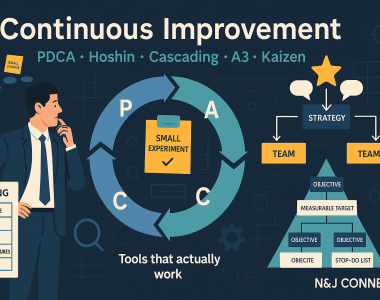
- Kaizen: Continuous improvement driven by all employees. Improvement wasn’t a task—it was a culture.
- Muda: The relentless elimination of waste—in time, motion, overproduction, defects, and more.
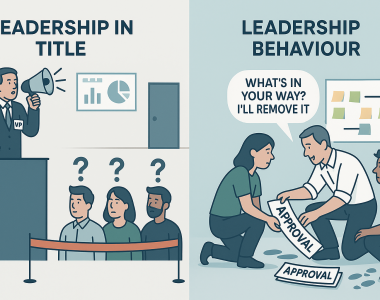
The brilliance of TPS? It was about respecting people by giving them the tools and trust to solve real problems.
1990: Lean gets a makeover (and its name)
Fast forward to 1990. The book The Machine That Changed the World by Womack, Jones, and Roos analyzed the global auto industry. When they studied Toyota’s system, they gave it a new name: Lean production.
The term stuck and spread.
Lean principles quickly moved into aerospace, electronics, logistics, healthcare, and eventually into service sectors like banking, IT, and government. The core message that organizations could reduce waste, improve flow and empower employees resonated far beyond the factory floor. Lean began its evolution from a manufacturing method to a global business philosophy.
LEAN spreads
As Lean matured, it spread into every function of the business. Purchasing, planning, HR, finance and even product development adopted Lean principles. Lean Six Sigma blended Lean’s flow thinking with statistical quality control. Public services and hospitals applied Lean to deliver better care with fewer resources.
And in today’s digital age, Lean meets technology. Enabling smarter, data-informed decision-making and more responsive operating models across entire supply chains. But here’s the danger: as Lean spreads, it risks losing its essence.
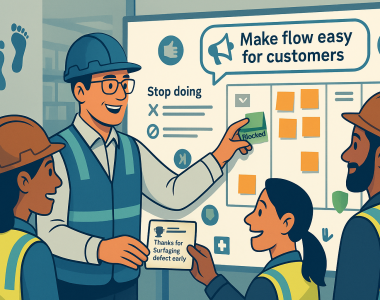
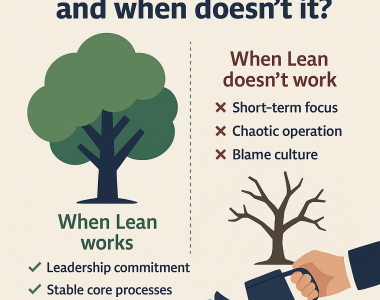
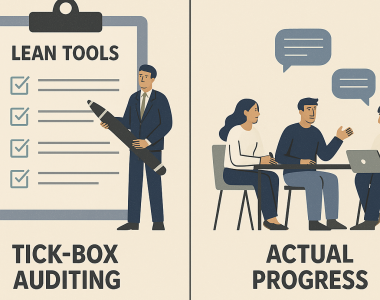
Too often, organizations adopt the tools -kanban boards, stand-up meetings, 5S- without embracing the thinking behind them. That’s when Lean becomes superficial and fails to deliver the transformation it promises.
That’s like buying gym equipment and expecting six-pack abs without changing your habits.
What history already taught us
Lean isn’t just about cutting costs or improving efficiency. It’s about creating value, empowering people, and solving problems at the source.
Its methods have evolved, but the mindset is timeless:
- Respect for people
- Long-term thinking
- Systematic problem-solving
- The courage to improve, always
Lean wasn’t born in a consulting firm. It grew out of necessity on the factory floors of post-war Japan, under pressure, with limited resources and high demands. That’s what gives it its strength and why it still matters.
In the next article, we’ll unpack what Lean is really about, because if you think Lean is just 5S and post-it notes… we’re just getting started.