
From Toolbox to way of thinking
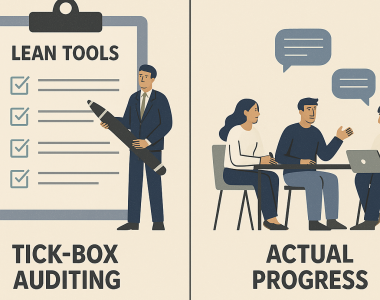
Before Lean became a set of tools on whiteboards, an audit form in Excel, or a checklist in a process improvement project, it was, above all, a way of seeing. Not seeing efficiency in spreadsheets, but seeing value, waste, and collaboration in the real world. On the factory floor. Between people.
In the previous article, we explored how Lean emerged. How the post-war circumstances in Japan led Toyota to develop something far more powerful than a methodology. Today, in article 2 of this 8-part series, we zoom in on what Lean really means.
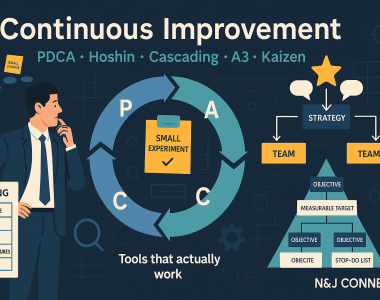
Because although Lean is now everywhere from logistics to finance, and from healthcare to government, it often gets stuck at the surface: 5S, stand-ups, post-its.
Lean without thinking is like cooking without tasting.
More than 5S and Post-its
Lean is about creating maximum value with minimum waste. But to do that well, you first need to understand what value actually is. Not for you as an organization, but for your customer.
In Lean, we distinguish three types of work:
- Value-adding work: actions the customer wants and is willing to pay for.
- Necessary waste: work that doesn’t add value, but is required (think quality checks or compliance tasks).
- Pure waste: work done simply “because we’ve always done it that way,” but which adds no value.
It comes down to this: Are we doing what truly matters? And: are we doing it together, improving a bit every day?
The five principles of Lean thinking
In the 1990s, James Womack and Daniel Jones described five core principles of Lean not as a step-by-step plan, but as a thinking framework to guide continuous improvement:
- Define what value is for the customer.
A manufacturer of industrial pumps had been optimizing its machining department for years—faster machines, shorter cycle times, higher output. Until a customer remarked: “We’re not buying precision-machined parts. We’re buying reliable delivery.” - Map the value stream.
In one factory, they discovered that 90% of total lead time was just waiting. No added value—just added cost. - Create flow.
One supplier moved from batch scheduling to one-piece flow. The result: lower inventory and faster throughput. - Let customer demand drive the process.
A wholesaler started replenishing shelves based on what customers actually bought—instead of what “inventory management thought made sense.” - Pursue perfection.
Don’t wait for big breakthroughs—focus on small improvements every day. Like in Formula 1, where tenths of a second matter, every improvement idea is taken seriously.
What makes these principles so powerful is that they reinforce each other. They don’t just change how you work, they change how you think. Not top-down, but together. Not once, but every day.
Lean as culture, not as project
Lean isn’t a campaign or a change initiative with an end date. It’s not a certificate on the wall. Lean is a culture. One where speaking up is normal. Where mistakes are seen as learning opportunities. Where people feel—and are given—ownership (responsibility equals mandate). Where people on the shop floor are empowered to solve problems, because they deeply understand the work.
In a Lean organization, you’ll notice different behavior:
- People ask questions instead of following assumptions.
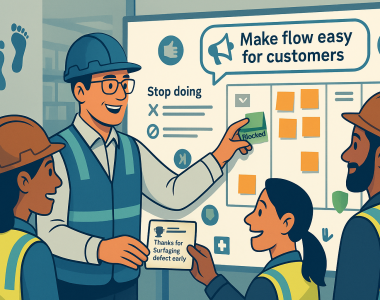
- Problems are made visible, not hidden.
- Improvement ideas come from the floor, not from management.
- Leaders are present, ask questions, and truly listen.
Processes are visible. Collaboration is open. And leaders? They’re not the boss but in fact the enabler. They go where the work happens, listen, and steer not by spreadsheet, but with behavior. And they don’t do this because they have to, but because it works.
Why Lean Initiatives Fail
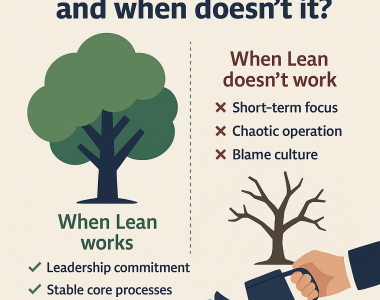
And yet… despite all the good intentions, Lean often fails in organizations. Not because people don’t want it, but because Lean gets reduced to a trick. A temporary project. An Excel dashboard filled with KPIs and color-coded zones.
The biggest pitfall? The culture doesn’t change.
When things get tough, organizations fall back into old habits: control instead of trust. Quick fixes instead of root cause analysis. And above all: treating improvement as an “extra task” instead of an integral part of the work.
A classic real-world example:
Non-Lean Environment – Finger-pointing and blame-shifting
Supervisor: “Why are these semi-finished products sitting idle again?”
Operator: “Well, assembly was late again. Not my problem.”
Supervisor: “Then they need to plan better. This is the third time.”
Operator: “As long as I hit my output, you won’t hear me complain.”
The discussion revolves around someone else’s mistake. No one asks whether the waiting time adds any value for the customer.
Lean Environment – Focus on value
Team Lead: “I see the flow between machining and assembly is stalling. What do you notice?”
Operator: “We only check the products after machining. If we do it right at the machine, we can keep things moving.”
Team Lead: “Great idea. What do you need to test it?”
Operator: “Let me adjust the checklist. Then we’ll start tomorrow.”
Same situation. Completely different conversation.
Leadership: The Real Difference
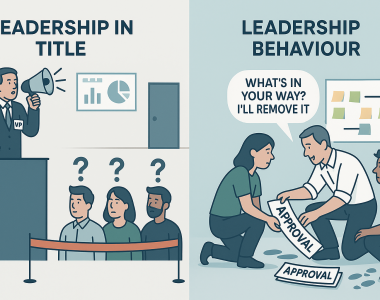
What makes the difference between these two worlds? Leadership.
Not the kind of leadership that tries to fix everything and chases every fire. But leaders who are willing to slow down to speed up. Who show up at the workplace, listen without judgment, and ask questions like: “What do you need to do this better?” instead of “Why did this go wrong?”
Spoiler alert! It’s not easy.
Many leaders walk a tightrope between short-term urgency and long-term strategy. Between fixing today’s escalation and building tomorrow’s ownership.
As one CEO put it before making a tough call:
“I know I can fix this in a day—the way we’ve always done it. But that won’t change anything. Or I can let it take a little longer this week and let my people learn to fix it themselves. It’s a choice: do I want to be right today, or effective tomorrow?”
That’s the leadership tension Lean demands. The courage not to jump in. The trust to step back. And the vision to look beyond the dashboard. Lean leadership isn’t heroic. It’s human. And above all: it’s servant-minded.
What We Really Mean by Lean
Lean isn’t about tools or three-day training sessions. It’s about a fundamental way of seeing. Seeing value. Seeing people. Seeing collaboration. It takes courage. It takes behavior. And it takes leaders who walk the talk.
The tools? They’re helpful. But without the thinking behind them, they’re useless.
Lean isn’t a project. It’s a habit.
Next week we’ll dive into article 3: the models and tools of Lean. Which ones actually help? Which ones are distracting? And more importantly: how do you use them to support thinking—rather than replace it?
See you then.