
In the first two articles of this series, we explored the origins of Lean and discovered that Lean is much more than a few post-its on a whiteboard or an Excel checklist. We concluded: Lean is a way of seeing, of thinking, of working together.
But how do you translate that way of thinking into action? In practice, we often turn to models and tools. And that’s understandable: they provide structure, make improvements tangible, and offer a sense of stability in complex organizations.
Yet there’s also a risk. What happens when the tool becomes more important than the goal?
Why models and tools are so popular
Lean can feel abstract. “Creating customer value and eliminating waste” sounds great, but what does that look like on a rainy Monday morning? That’s exactly where tools and models offer a solution.
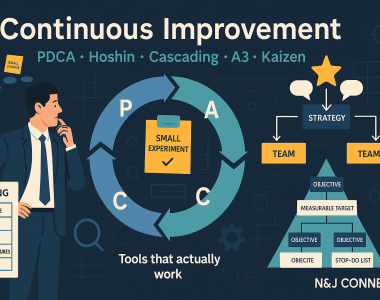
Familiar names like 5S, Kanban, Kaizen events, A3 problem-solving, Hoshin Kanri, and Value Stream Mapping are used worldwide to provide structure to improvement initiatives.
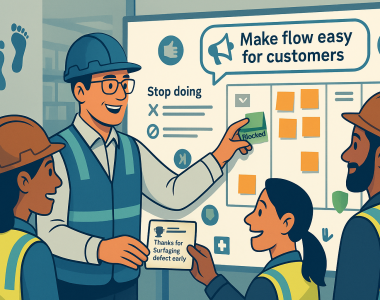
They all have one thing in common: they make things visible. A Kanban board instantly shows where work is getting stuck. A 5S audit gives immediate clarity on order and cleanliness. A Value Stream Map highlights where time is being lost.
And let’s be honest: that feels good. It gives control and reassurance.
The power of the right tools
When used well, tools can be incredibly powerful. They make abstract principles tangible and spark conversations about improvement.
- 5S doesn’t just create order, it also improves safety and standardization.
- Value Stream Mapping often exposes bottlenecks in just one afternoon that would otherwise remain hidden for months.
- Kanban prevents work from being “pushed through” when there’s no customer demand.
One great example came from a company struggling with lead times. In the meeting room, the answer was always the same: “We just need to work harder.” Until they decided to map their process in a simple Value Stream Map.
The result? 80% of the time, parts were simply waiting for the next operation. No expensive new machines or additional shifts were needed; just better flow. With a few simple Kanban signals and a 5S action plan, lead time was cut in half in three months. Not by working harder, but by working smarter together.
When tools become a pitfall
And yet… we often see it go wrong. Tools are introduced without any clear reason. A 5S program is rolled out simply because “we once had a training on it.” Kanban cards hang on a rack simply because “that’s what Lean looks like.”
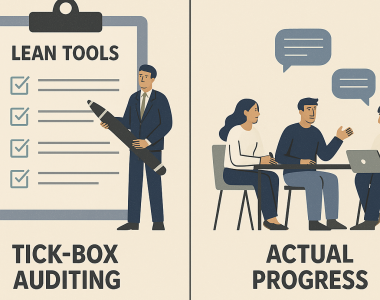
The result? Pseudo-improvement. Everything looks neat, audit scores are high, but no one understands the purpose. A team leader once told me during a Gemba walk:
“Everything is in its assigned place but since, I have to walk further to get my tools”.
That’s how an enabler becomes an obligation. The conversation about value and improvement shifts to simply ticking boxes. And that’s exactly what Lean is not about.
The human side: tools as a conversation starter
Lean isn’t about perfectly executing a checklist. It’s about having the conversation: “Are we doing what really matters? Is this helping our customer? How can we make it better?”
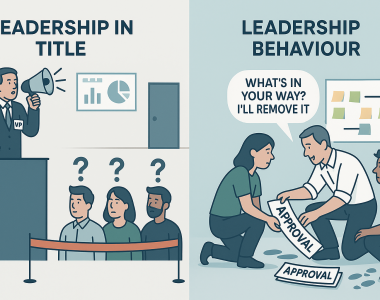
Tools are just a means to start that conversation. They should spark curiosity, not fear. A Lean leader uses a tool not to point fingers, but to learn together.
As one team leader put it:
“I don’t use our Kanban board to catch someone making a mistake, but to see where we can help each other.”
That’s the difference between Lean as a culture of learning and improvement and Lean as a collection of tricks no one really understands.
In summary
Models and tools are no magic solution, but they can deliver amazing results—if supported by the right mindset and behaviour. They should support Lean thinking, not replace it.
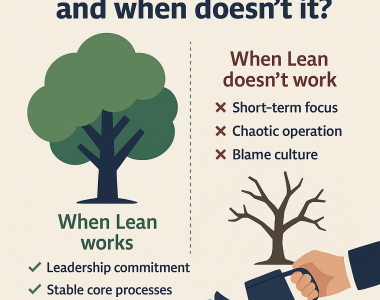
In the next article, we’ll take a closer look at when Lean works—and when it doesn’t. Because sometimes, the timing, culture, or approach simply isn’t ready for Lean. And understanding that is just as important.
And you?
Which Lean tool has truly helped your organization? And which one felt more like a tick-box exercise? We’d love to hear your experience.