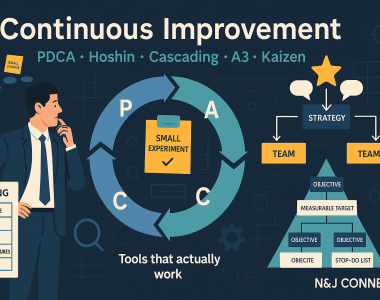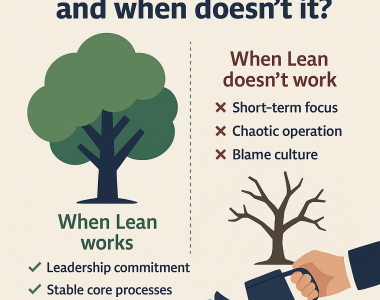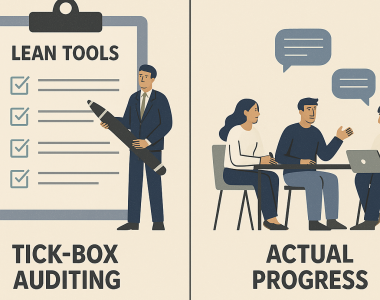

In the last article, we explored when Lean works and when it doesn’t. There’s a tougher truth underneath: even with promising conditions, a lot of change still stalls. Not just Lean. ERP rollouts, reorganizations, agile transformations. Different labels, same gravity: human behavior, conflicting priorities and limited attention.
So why are we talking about change in a Lean series? Because, Lean = change. Lean adaptation alters how decisions are made, where time is spent, who owns problems, how work flows, what leaders do in a day, and how success is measured. That’s not a tool swap; it’s a habit shift. And habit shifts don’t fail because people are foolish. They fail because people are busy, systems are sticky, and organizations underestimate what it takes to change routines at scale.
The patterns behind failure
Why is it that most change fails, even though the foundation seems legit? It’s a complex and multi-faced monster a lot of writers have tried to explain in thick books. We’ll try to lay it out for you in 5 short principles. Studies find that in unsuccessful change attempts, it is highly likely two or more principle were present.
What looks like resistance – is often overload or a missing reason.
No compelling “why.”
Kotter’s work makes a simple point that leaders still underestimate: change needs an urgent, human reason to exist. A slide deck with targets is not the same as a story people can remember, repeat, and act on. When the “why” stays abstract, the old way wins by default. Kotter also stresses over-communication of vision, far beyond what feels comfortable. Because clarity and repetition are what turn intent into shared direction.
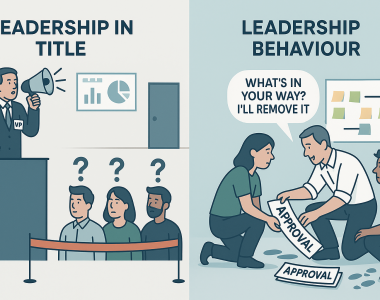
Leadership in title, not in behavior.
Prosci’s longitudinal research consistently finds that active and visible executive leadership is one of the strongest predictors of success. It isn’t the logo on the charter that moves the needle; it’s the leader showing up at the work, communicating directly with employees, aligning middle managers, and removing real obstacles. Where leadership is distant or episodic, teams quickly infer that the change is optional and adoption stalls.
Change stacked on chaos.
Large studies from BCG and McKinsey have long observed that only a minority of transformations achieve their full objectives, and that odds get worse when organizations overload themselves with simultaneous initiatives. Spreading attention thin does not create momentum. The practical implication is simple but vital: create capacity and focus before you scale. Decide what not to do so the change has space to root.
Blame culture, rising fatigue.
Research summarized in Harvard Business Review and Gartner tracks a sharp increase in the volume and pace of enterprise change. Employees are increasingly navigating more and more concurrent initiatives each year. The predictable by-product is fatigue: people conserve energy, avoid risk, and disengage from yet another program. In that context, blame kills learning. Psychological safety and genuine participation aren’t “soft” ideas; they are conditions for truthful signals and early problem-solving.
Process without people.
PMI’s Pulse of the Profession repeatedly links “power skills” like communication, stakeholder engagement, and leadership to change program outcomes. Training alone doesn’t change behavior; roles, incentives, rituals, and language have to shift with the process. When organizations install a new workflow on top of unchanged habits, the workflow loses. Aligning how people are supported and recognized with the new way of working is what turns design into daily practice.
Respectable traps
Some of the most professional-looking practices quietly stall change. Pilots that never end feel safe but never scale. Reframing change as a “project” creates a ceremonial hand-off moment after which ownership evaporates, precisely the opposite of what sustained leadership requires. Broadcast emails substitute for dialogue, ignoring what Kotter called for: a clear, human story repeated often and reinforced in person. And when you rely only on lagging KPIs from behind your desk, you discover the problem precisely when energy has already drained away.
Knowing early that you’re drifting
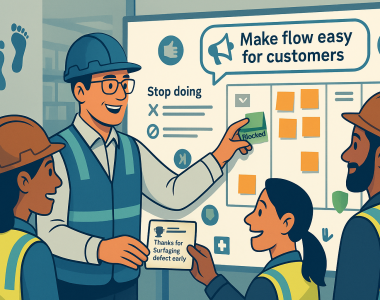
You don’t need to wait for quarter-end. Listen for whether teams can explain in one sentence, why this change matters. Watch whether the new way shows up outside meetings. Notice how long it takes for someone who’s stuck to get help. Look for leaders on the floor each week, asking “What’s in your way?” and then actually removing it. Pay attention to when defects and delays are raised early; when they’re small, or late; when they’re expensive. If these signals are weak, the change is already leaking energy, no matter what the big dashboard says.
What actually helps
The changes that stick are rarely dramatic; they’re consistent. One clear story, told by many voices. Leaders who remove one or two real obstacles every week. A stop-doing list alongside the plan so capacity truly appears. Short, dependable meetings where teams surface impediments and leaders make -and keep- commitments. Recognition not only for the result, but for the behavior that makes the result possible.
The question in the mirror
Before you “roll out” anything, make one brief check. Yes, look at process stability, trust, and long-term commitment. But put this at the center:
Am I willing to change my own behavior—and ask my colleagues to do the same?
If the honest answer is “not yet,” that isn’t failure; it’s maturity. Create the conditions first. Then start.
Conclusion
Lean is a change program because it rewires how an organization thinks and works. Most change doesn’t fail on design; it fails in the gap between announcement and daily practice. Close that gap with presence, space, steady leadership and progress will become a habit.
Next up: How to adapt the leadership behaviors, rhythms, and reinforcements that make improvemen