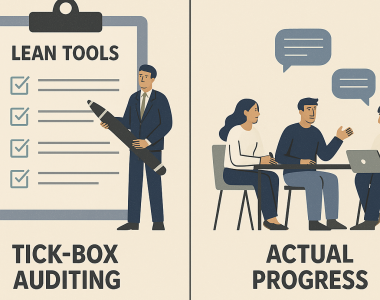

In our previous article S2E5 we showed why so many well designed changes stall. The single biggest reason is leadership. Being present at the work. Creating space, trust, rhythim, reliability and balancing rewards with consequences is essential for succes. We concluded that leaders who are not truly ready to change their own habits, won’t change their organization either.
So let’s dive in the ‘how’ of the leadership that gives you the best chance of succes. We will discuss five leadership behaviors that make change stick, a simple daily and weekly cadence, a performance behaviour management install that turns intent into observable habits, the few leading signals that predict success and a first ninety day plan to close off.
Why Lean leadership decides outcomes
In essence, Lean is a redesign of routines. It rewires who decides, how problems can be avoided and solved, how fast help arrives, and how value is added. Every organisation is able to start motion using tools. Only leadership sustains true change in thinking and behaviour. So again, If leaders don’t change their own habits, the organisation won’t change either.
Think of leadership as the operating system for change. Vision sets direction. Presence creates trust. Cadence creates momentum. Consequence creates standards. Miss one and energy leaks out of the system.
Five Lean leadership behaviours that make change stick
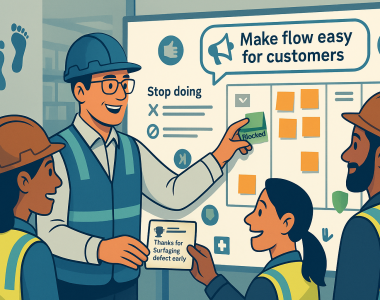
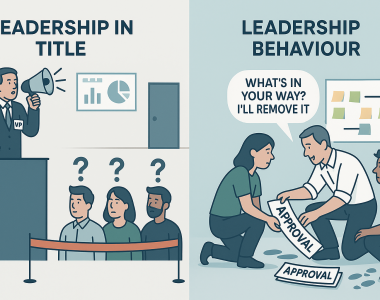
- Show up at the work Go where value is created. Ask what is in the way. Remove one real obstacle at a time. Keep a visible list of impediments and track time to clear them.
- Tell one clear story The strength of storytelling to achieve a sense of purpose is unmatched. Explain in one sentence why this change matters now and for whom. Repeat it everywhere. Only when you are bored of saying it, the organisation is starting to hear it.
- Create simple rhythms Rythim creates reliability and predictability. Teams need this to focus on the value they need to create. Creating rhytim allows to spot deviations because something should have been done at a certain time, day in, day out. Rhythm beats intensity.
- Protect capacity Stop doing low value work so there is room to work on improvements. Cancel or combine meetings. Freeze new projects until the current ones flow. No capacity means no change.
- Reward behaviour, not only results Recognise people who surface problems early, who run experiments, who standardise and share. Results follow repeated behaviour. If you only reward output, you will get short cuts.
Lean leadership cadence that works
Start small and keep it dependable.
Daily Ten minute team meetings that focus on flow, safety, quality and one improvement. Leaders listen, make one commitment, and report back the next day.
Weekly Ninety minute Gemba with two questions. What is blocking value for the customer? What did we learn this week? Leave with signed actions and names attached. Close last week before opening a new list.
Monthly One page review of the few vital indicators. Flow stability, time from signal to help, number of improvements closed, first time right, customer promise kept. Discuss causes, not colours.
Quarterly Strategy deployment check. Are we still solving the right problems. What stops the next step. What must we stop doing.
Leading indicators that predict progress
Lagging metrics tell you the score. Leading signals tell you if the game plan is working. Track a few that matter.
- Percent of leaders on the floor each week
- Impediments removed per week and median days to clear
- Time from defect or delay reported to first help
- Number of small improvements implemented by teams
- Share of leaders who can state the change story in one sentence
When these move, the classic metrics follow. Lead time drops. Quality improves. Morale climbs.
Scripts leaders can use tomorrow
- What’s in your way today and what help do you need?
- If we fix only one thing this week, what should it be?
- Show me where the work is slower than it should be, right now
- What did we learn from this defect and how do we lock the learning?
- What can I remove from your plate so you can improve this process?
Patterns that quietly kill change
Hero mode where leaders jump in and fix everything. Email leadership where direction lives in inboxes. Vanity dashboards that hide weak standards. Endless pilots that never scale. Tool theatre that looks busy but changes nothing. If you see these, stop and reset the cadence.
First ninety days for Lean leadership
Days 1 to 30 Write the one sentence story. Set the daily and weekly rhythms. Begin the impediment list. Remove three real obstacles.
Days 31 to 60 Teach simple problem solving at the workplace. Standardise one critical routine. Celebrate one team improvement publicly.
Days 61 to 90 Tighten the review. Protect capacity by stopping low value work. Expand the cadence to the next area only when the first one holds on its own.
Performance behaviour management for Lean leadership
Performance behaviour management (PBM) is the application of behavioural science to work. Rooted in Organizational Behaviour Management and reinforcement theory, it focuses on the antecedent–behaviour–consequence chain and the measurement of observable behaviours as the causal path to results. PBM is not annual appraisal or generic “culture.” It is a discipline that examines which repeatable actions occur, how often, under which cues, and with what immediate consequences.
Why it matters in change
Change succeeds when daily behaviours change predictably. PBM explains and influences that shift through:
- Reinforcement dynamics. Immediate, frequent, and certain consequences shape habits more powerfully than delayed, uncertain rewards tied to lagging KPIs. This is why local recognition and friction removal often beat distant bonuses.
- Attention and feedback effects. Feedback interventions work when they direct attention to the task and the next behaviour; self‑focused or delayed feedback can depress performance. PBM keeps signals close to the work, making learning cycles short.
- Goal mechanisms. Specific, challenging goals raise effort and persistence when paired with feedback and commitment. In PBM terms, clear behavioural goals create stable “targets” the system can actually hit.
- Social learning and norming. When leaders model the target behaviours and peers see them reinforced, adherence spreads via social proof, raising psychological safety to surface problems earlier.
Fit with Lean
Lean depends on repeatable human routines making problems visible, experimenting scientifically how to solve and standardising what works. PBM gives these routines a scientific spine: it treats behaviours as leading indicators, ensures consequences support the Lean way (respect and learning over blame), and reduces the drift back to old habits (extinction) that often follows tool‑only roll‑outs.
Without PBM, change rests on intention, tools, and slogans. With PBM, leadership has a validated mechanism for how behaviours form, stabilize, and scale. So Lean does not fade when the dashboard turns green.
Why this works
Clear goals, specific feedback and positive reinforcement are among the most studied drivers of performance. They turn leadership from intent into daily practice, and they give Lean the human engine it needs.
Bottom line
Change is not a project. It is a leadership habit that shows up in calendars, in questions asked, and in what gets removed each week. If you do not change how you lead, nothing else will change for long.
Next in S7 We move from leadership cadence to continuous improvement as a system. How to make sure improvement isn’t a one time fly.